

Commons:Village pump/Copyright
This Wikimedia Commons page is used for general discussions relating to copyright and license issues, and for discussions relating to specific files' copyright issues. Discussions relating to specific copyright policies should take place on the talk page of the policy, but may be advertised here. Recent sections with no replies for 7 days and sections tagged with {{section resolved|1=~~~~}} may be archived; for old discussions, see the archives.
- One of Wikimedia Commons' basic principles is: "Only free content is allowed." Please do not ask why unfree material is not allowed at Wikimedia Commons or suggest that allowing it would be a good thing.
- Have you read the FAQ?
- Any answers you receive here are not legal advice and the responder cannot be held liable for them. If you have legal questions, we can try to help but our answers cannot replace those of a qualified professional (i.e. a lawyer).
- Your question will be answered here; please check back regularly. Please do not leave your email address or other contact information, as this page is widely visible across the Internet and you are liable to receive spam.
- Please do not make deletion requests here – instead, use the relevant process for it.
 |
SpBot archives all sections tagged with {{Section resolved|1=~~~~}} after 1 day and sections whose most recent comment is older than 7 days. |
Are circuit diagrams below TOO?
[edit]I've found this image on English Wikibooks, and am considering whether it should be exported to Commons. The question is: are educational circuit diagrams below the threshold of originality in the United States? JJPMaster (she/they) 02:53, 8 November 2025 (UTC)
- I would say one that simple certainly is below TOO. - Jmabel ! talk 18:41, 8 November 2025 (UTC)
- @Jmabel: What about this one? b:File:Mesh1.png JJPMaster (she/they) 19:15, 10 November 2025 (UTC)
- Not sure. The key question would probably be: would anyone else diagram this significantly differently? If not, then it is probably below TOO. Jmabel ! talk 22:08, 10 November 2025 (UTC)
- The annotations there—"loop1", "loop2", and "I1", "I2"—would probably be a more likely issue than the completely conventional circuit diagram. - Jmabel ! talk 22:12, 10 November 2025 (UTC)
- @Jmabel: Thank you. I'd like to ask about just one more: b:File:Electronics TTLNOTPRAC01.PNG. JJPMaster (she/they) 17:32, 12 November 2025 (UTC)
- I'd expect that to be below TOO. Certainly without the colors it would be, and it's hard to see how adding color to highlight something would push it over the line.
- In case I haven't said this: TOO is always a judgement call. My opinion is just that: my opinion. Someone else might disagree, so please do not be offended if you upload these and they are later deleted. - Jmabel ! talk 19:20, 12 November 2025 (UTC)
- @Jmabel For the Mesh1.png, I would agree the Loop1 & Loop2 parts might need professors to check whether simple or not, the 1k, 2k and 3k parts (probably also affects the R1 within Electronics RC01.PNG) may be likely. As for third one (Electronics TTLNOTPRAC01.PNG), do we have ideas whether the "sun"-like icon on middle-right is simple and commonly used, as well as the center circle that contain middle left dash, middle pipe, right-top slash and right-bottom arrow? Liuxinyu970226 (talk) 13:18, 19 November 2025 (UTC)
- The middle circle is a standard way of representing a transistor. I don't know the "sun"-like icon in terms of its use in a circuit diagram, but is certainly too simple to copyright in the U.S. - Jmabel ! talk 06:14, 20 November 2025 (UTC)
- @Jmabel For the Mesh1.png, I would agree the Loop1 & Loop2 parts might need professors to check whether simple or not, the 1k, 2k and 3k parts (probably also affects the R1 within Electronics RC01.PNG) may be likely. As for third one (Electronics TTLNOTPRAC01.PNG), do we have ideas whether the "sun"-like icon on middle-right is simple and commonly used, as well as the center circle that contain middle left dash, middle pipe, right-top slash and right-bottom arrow? Liuxinyu970226 (talk) 13:18, 19 November 2025 (UTC)
- @Jmabel: Thank you. I'd like to ask about just one more: b:File:Electronics TTLNOTPRAC01.PNG. JJPMaster (she/they) 17:32, 12 November 2025 (UTC)
- @Jmabel: What about this one? b:File:Mesh1.png JJPMaster (she/they) 19:15, 10 November 2025 (UTC)
Request for review
[edit]To interested users based in Belgium or possibly Benelux area, kindly review all of the images under Category:FOP (tagged with {{FOP}}). These apparently show stained glass windows in the city of Gent. Unsure if those are eligible for {{FoP-Belgium}}. Regards, JWilz12345 (Talk|Contributions) 05:19, 11 November 2025 (UTC)
- Hi @JWilz12345, I am not planning to review these images. And possibly this will not help either, but of interest perhaps. The discussion about FoP in Churches in the Netherlands did not lead to consensus. I asked for advice from a lawyer, @Arnoud Engelfriet, who kindly invested some of his time, but his advice was contested by some other Wikimedians. You kind find the discussion here: [1] Stained glass in other public buildings then churches might fall under FoP. Regards, Ellywa (talk) 19:10, 16 November 2025 (UTC)
- I think we should disregard opinions by non-lawyers when we have a lawyer's opinion. It always surprised when people pretend to know more than the professionals. Yann (talk) 19:18, 16 November 2025 (UTC)
- If they are an intellectual property rights lawyer, and familiar with the laws of the country in question, sure, but I'm pretty comfortable saying that if you grabbed (say) the average American lawyer and asked them something about (say) copyright in Communist-era Romania, they would know less than several dozen of the regular participants on this page. - Jmabel ! talk 22:09, 16 November 2025 (UTC)
- I agree with Jmabel here. Disregarding non-lawyers just because you have an opinion from a lawyer is a bad idea. In my day job I deal with lawyers quite frequently and they are just as fallible as any other human. In my own field of expertise (not copyright) I regularly advise and correct lawyers who misinterpret my subject area. A lawyer with suitable experience can provide a persuasive argument but that doesn't automatically invalidate all other opinions. From Hill To Shore (talk) 23:11, 16 November 2025 (UTC)
- @Ellywa I'm convinced on the applicability of church interiors under Dutch FoP (and possibly Belgian FoP since Romaine said in a past discussion that Belgian FoP is similar to the Dutch rules concerning public space and non-modification rules), as long as the church interior is always open during worship services and that there are no restrictions in visiting indoors (like what JopkeB inferred in the discussion you mentioned.
- However, I doubt the stained glass art photographed by Cesarine132 are located inside churches. Many of the images have source stated as "Dienst Bevolking (voormalige openbare bibliotheek)". I'm not sure if it implies the images were obtained from the library or depicted stained glass inside the said library. JWilz12345 (Talk|Contributions) 00:03, 17 November 2025 (UTC)
- According to COM:FOP Belgium, "an explanation that was attached to a draft version of the freedom of panorama provision stated that the provision was intended to apply to locations that are permanently accessible to the public, such as public streets and squares, and that the provision was not intended to apply inside of public museums or other buildings that are not permanently open to the public. According to the explanation, if a work of art is situated inside a building that is not permanently open to the public, then the artist may not have expected public exhibition of the work." JWilz12345 (Talk|Contributions) 00:14, 17 November 2025 (UTC)
- So there is a difference between Belgium and Dutch FoP. As far as I know: In the Netherlands FoP also applies to freely accessible public buildings that are not PERMANENTLY open to the public, like public libraries and town halls. And apparently in Belgium FoP does not apply to those buildings. JopkeB (talk) 07:38, 18 November 2025 (UTC)
- I think we should disregard opinions by non-lawyers when we have a lawyer's opinion. It always surprised when people pretend to know more than the professionals. Yann (talk) 19:18, 16 November 2025 (UTC)
Are images and videos of North Korean weapons systems or military parades in the public domain?
[edit]Dear community.
This question has been on my mind for about two weeks now. It's about whether images and videos from North Korea depicting weapons such as missiles, vehicles, or other items, or even videos of military parades, are truly in the public domain? The license used for these images and videos is {{PD-KPGov}}, but upon closer inspection, this license does not mention images in this sense. Furthermore, it requires an additional license for the United States, which cannot be provided in this case. It also mentions other countries where the material may not be in the public domain. As I interpret the license, such photos or videos do not fall under 1. Documents for state management, 2. Current news, or 3. Information data. The suggestion was made to open a thread here so that more users could comment on the problem. What I expect: A consensus should be reached that the license and also Commons:Copyright rules by territory/North Korea should be adjusted accordingly. The aim should be to make it easier in the future for such material to be deleted more quickly, or to allow it to be uploaded to Commons with a clear conscience.
I would like to invite the following users to participate in the discussion: @Klgchanu: who uploaded the files and videos, @King of Hearts: , which converted my speedy delete requests into normal delete requests or restored files upon request under COM:UNDEL, @Yann: , who has speedy deleted some files in the recent days, and also @Namoroka: , who the following mentioned at Commons talk:Copyright rules by territory/North Korea: To summarize, documents for state management, current news or information data, and notifications created after February 1, 2006, cannot be used commercially and should be removed from Commons. e.g. And regardless of above, videos, photos, and other content from Korean Central News Agency (KCNA), Korean Central Television (KCTV), or other similar government agencies have always been protected by copyright. e.g. That is exactly how I feel in this case and the problem is being discussed there, but no result has been reached so far.
Further links
[edit]Open deletion requests in this regard:
Note: The videos are from YouTube and they have no YouTube license.
- Commons:Deletion requests/File:KN-25 TEL.webp (A webp extension suggests that the file was not extracted from the linked video as indicated, but rather originates from some website.)
- Commons:Deletion requests/File:Kim Jong Un Oversees Test-fire for 600mm Multiple Rocket Launcher.webm
- Commons:Deletion requests/File:Hwasong-20.jpg (We have the same problem here. It's an Allamy stock image.)
- Commons:Deletion requests/File:Hwasong-18.jpg
- Commons:Deletion requests/File:First Test-Fire of New-Type ICBM Hwasongpho-18.webm
- Commons:Deletion requests/File:Miltary Parade Marks 80th Founding Anniversary of WPK.webm
- Commons:Deletion requests/File:Military Hardware Exhibition Defence Development-2024.webm
- Commons:Deletion requests/File:Hwasong-11E.jpg
- Commons:Deletion requests/File:Hwasong-19.jpg
- Commons:Deletion requests/File:최신형대륙간탄도미싸일《화성포19》형시험발사 성공적으로 단행.webm
- Commons:Deletion requests/File:화성-16나형.png
- Commons:Deletion requests/File:미싸일총국 신형극초음속중장거리탄도미싸일시험발사 진행.webm
- External link: http://kcna.kp/en (Which contains the copyright notice: 조선중앙통신 Copyright © 2000-2025 by www.kcna.kp)
Let the discussion begin. Best regards, זיו「Ziv」 • For love letters and other notes 22:50, 13 November 2025 (UTC)
- Thank you for opening this discussion. My thoughts are as follows:
- I saw a similar discussion taking place at Commons talk:Copyright rules by territory/North Korea, but there seem to be some differences.
- Although copyright fees are technically being paid to North Korea, it is also true that the money is frozen in court due to the ban on remittances to the North. However, in practice, only one news agency (YNA) actually pays copyright fees to the Korean Central News Agency (KCNA). Other news organizations do not pay any copyright fees at all and still use the photos.
- Even YNA, the only outlet that pays copyright fees, does not pay for photos from Rodong Sinmun, even though those also require copyright payments.
- Ironically, there are cases where the North Korean government has used photos from South Korean news agencies without paying any copyright fees.
- (They stated: “We used a photo, which is a still frame from videos reported by various global media such as NBC in the U.S., Fox News, and Reuters in the U.K.”)
- Due to the closed nature of North Korea, it is practically impossible to raise legal copyright claims.
- Lastly, uploading photos of North Korean weapons is done to help readers understand the articles, not for any other purpose. If I were a reader, I believe it would be much easier to understand if images of the weapons were included.
- Klgchanu (talk) 06:01, 14 November 2025 (UTC)
- Hello @Klgchanu. Thank you for your quick reply. Your desire to illustrate an article is perfectly understandable, as you want the readers of the article to be able to visualize the weapons. That's precisely what Wikimedia Commons is for: hosting free media so that language projects can use it to populate their articles. Wikimedia Commons isn't just for Wikipedia, though; anyone can copy a link and embed it on their own websites. Even news portals use images from Commons for their articles and label them accordingly. However, this is not the real problem; Commons only hosts material whose origin can be clearly proven and correctly licensed, which, in my opinion, is not the case here. However, I am happy to be convinced otherwise. זיו「Ziv」 • For love letters and other notes 08:24, 14 November 2025 (UTC)
- If the issue is just illustrating the English-language Wikipedia, the best solution is probably en:Wikipedia:Non-free content; if the illustrations are crucial to the article, they should pass muster. Some other languages, but not all, also allow have similar policies. - Jmabel ! talk 19:38, 14 November 2025 (UTC)
- @Jmabel: As I see it, the uploader is primarily interested in adding images to koWP and possibly also enWP. The Korean Wikipedia also allows fair use material, but the right to upload files must be applied for there; see ko:위키백과:비자유 저작물의 공정한 이용. זיו「Ziv」 • For love letters and other notes 23:04, 14 November 2025 (UTC)
- That's right. Some images are non-free contents and have already been uploaded. However, during the upload process, the upload was made at a low resolution, making it impossible to properly understand the appearance of the missile. The Korean manager has been advised that it seems military equipment so can possible to upload as a free contents.
- Klgchanu (talk) 03:33, 15 November 2025 (UTC)
- @Klgchanu: But that's exactly also the practice followed by the English-language Wikipedia. The image is reduced to low resolution, making it pointless to copy it from there, as it's only meant to illustrate the article. Commons was ultimately chosen because it was about achieving a higher resolution and if I understand right, because an manager (administrator?) suggested it could potentially be free content and should uploaded to Commons.
- It would be helpful if you could bring this discussion to the attention of this Korean manager. They are welcome to comment on it here. Just use
{{ping|Username of this person}}, and they will receive a notification that they have been mentioned here on Commons. זיו「Ziv」 • For love letters and other notes 07:04, 15 November 2025 (UTC)- OK. Thank you. @앵무:
- Klgchanu (talk) 07:58, 15 November 2025 (UTC)
- Since it seems like he hasn't replied, I'll continue talking.
- This is a bit of a different story, but if change the licenses for those files to YouTube licenses, will there be no issues?
- Klgchanu (talk) 02:36, 16 November 2025 (UTC)
- No, that's not possible. A YouTube license is only valid if the video material is marked accordingly on YouTube. זיו「Ziv」 • For love letters and other notes 03:32, 16 November 2025 (UTC)
- @Jmabel: As I see it, the uploader is primarily interested in adding images to koWP and possibly also enWP. The Korean Wikipedia also allows fair use material, but the right to upload files must be applied for there; see ko:위키백과:비자유 저작물의 공정한 이용. זיו「Ziv」 • For love letters and other notes 23:04, 14 November 2025 (UTC)
Airplane liveries and COM:De minimis
[edit]Hello,
I'd like to gather some input about COM:DM in relation to airplane liveries and possible copyvios. We have some categories like Category:JA604A (aircraft) in R2-D2/BB-8 livery and Category:Aircraft with a Planes (film) livery. The planes depicted do have some copyrighted art on them, a Star Wars Droid for the first and characters from the animated movies Planes / Planes 2 for the second collection. I don't think that there's another "saving grace" like FOP or another copyright limiting statute applicable. I know about the bullet points in COM:DM#Guidelines:
- the file is in use to illustrate X
- the file is categorised in relation to X
- X is referenced in the filename
- X is referenced in the description
- X cannot be removed from the file without making the file useless
- from other contextual clues (e.g., by comparison with a series of uploads by the same uploader) X is the reason for the creation of the file.
It's irrefutable that the categorisation is in relation to the protected X, and the filename and descriptions also quite often contain something along the lines of Star Wars or Planes. Additionally, in can be inferred that this kind of pop art livery is a prime target for planespotters, so the "contextual clues" are also prominent. On the other hand, I did some kind of test for myself. I know that we're using a rule of thumb (or the admins in DR do) that says "If a casual onlooker won't notice the absence of the copyrighted element, then it's likely De minimis (which works well when comparing to the different law excerpts given on the DM page). So, I used the category slideshow and tried to simulate myself being a casual onlooker - I came to the conclusion that e.g. on File:All Nippon Airways, Boeing 767-381(ER), JA604A (23802227733) (cropped).jpg, the Droid near the tail is discreet enough to get overlooked by such a casual onlooker. Can I get more input for that analysis, if I'm right in concluding "De minimis is applicable"? Regards, Grand-Duc (talk) 17:58, 14 November 2025 (UTC)
- For most of these, I think de minimis would apply. When the images are cropped specifically to show the livery and it's mentioned in the file description or title (e.g. File:LN-RCY Boeing 737-800 SAS.jpg), it's probably not de minimus any more. Nosferattus (talk) 19:47, 14 November 2025 (UTC)
- That being said, if the promotional livery truly is de minimis, the image should not be categorized based on its presence. Omphalographer (talk) 22:02, 14 November 2025 (UTC)
- That's a keystone of my problem, yes. But right now, I'm a bit reticent in flooding the DR queues with these images, si I'm asking here for more opinions. Regards, Grand-Duc (talk) 22:11, 14 November 2025 (UTC)
- That being said, if the promotional livery truly is de minimis, the image should not be categorized based on its presence. Omphalographer (talk) 22:02, 14 November 2025 (UTC)
- De minimis or not, it would seem to be incidental, as it is unavoidable when making a photograph of the plane. Much like the Ets-Hokin decision, a photo of an entire bottle is not derivative of a label on that bottle (in the U.S.), even if copyrightable -- it would be a photo focusing on the label itself to cross that line. Stuff like this would seem similar to me. This aspect is mentioned on the COM:DM page even if technically a different situation. Carl Lindberg (talk) 02:26, 21 November 2025 (UTC)
Copyright status of manuscript scans?
[edit]Hello! Copying a question I first raised at en.wikisource: I would like to start a transcription project for Le Viandier at Wikisource. The hosting database (BNF) states that commercial use (I assume of a scan itself?) is prohibited, which would suggest on first glance that it could not be uploaded to Commons. However, because of the age of the work (14th-15th century), I am fairly certain that the text content (and potentially a simple scan) of the book is in the public domain. I took a look at Commons:When to use the PD-Art tag, but I still am not quite sure whether uploading this PDF to Commons would be allowed—could someone confirm here? Thank you! —Kittycataclysm (talk) 03:46, 15 November 2025 (UTC)
- PD-Scan is the template you would want to use. I don't see any reason why you couldn't upload this. Abzeronow (talk) 03:51, 15 November 2025 (UTC)
- @Kittycataclysm: The BNF claims a copyright on anything and everything. These claims are nonsense. This has never been under a copyright, as it was created before the concept of copyright was created. Scanning an old book doesn't create a new copyright. Yann (talk) 14:24, 15 November 2025 (UTC)
- @Abzeronow@Yann Thank you both! I will move forward with uploading this. Kittycataclysm (talk) 15:40, 15 November 2025 (UTC)
Isn't it proprietary?
[edit]
File:Felixhead.gif seems like it is proprietary. If it can be PD because of 70 years or something like this (I doubt it), it is certainly not gpl+sa? DustDFG (talk) 10:45, 15 November 2025 (UTC)
- This appears to be a derivative work of the modern (1950s) version of Felix the cat, which is copyrighted. See Commons:Deletion requests/File:Felix the cat.svg. Thanks. Tvpuppy (talk) 12:27, 15 November 2025 (UTC)
- @DustDFG: The file was nominated for deletion back in 2008, but was kept. According to en:Felix the Cat and Commons:Character copyrights#Animation Origin, the character's original imagery entered into the public domain well before the file was uploaded in 2008, but the name is still trademarked. Commons isn't really worried about COM:TRADEMARK when it comes to the content it hosts. As long as the character's imagery is in the public domain, it's OK for Commons to host. As for the licensing of the file, you can't create a new copyright for a public domain work if what you do is really nothing more than a slavish reproduction of the original work; however, I think you can incorporate a public domain work into a new creative work to create a derivative work, and you can claim copyright over the new work. Maybe that's what the uploader did in this case and in the sense created a piece of COM:Fan art per COM:CHAR. Now, having posted that, if this file is of a more recent still copyright-protected version of the character, then perhaps the original DR decision to keep was incorrect; the existence of multiple versions of the character wasn't mentioned in the 2008 DR and there's no mention of the 2008 DR is the 2022 DR for the file that ended up being deleted; so, perhaps nobody connected the dots until you posted here. The file could be DR'd again and the concerns about this be a more recent version could be pointed out. -- Marchjuly (talk) 12:44, 15 November 2025 (UTC)
- Looks like I originally nominated it for deletion in 2008, funny. Anyway, everything up to 1930 is PD now in the US, and here's a 1930 Felix for comparison. I'd say this version is fine. -Nard (Hablemonos) (Let's talk) 14:34, 15 November 2025 (UTC)
Looking for clarification on Smithsonian's "open access" images
[edit]I had planned to upload some images from Smithsonian's "open-access" images website (https://www.si.edu/openaccess). Their home page and FAQ's page state that all of the open-access images are CC0 (https://www.si.edu/openaccess/faq).
However, after reading their "Terms of Use", I'm really confused. It says they can't guarantee that their CC0 images aren't free from other rights: "The Smithsonian does not guarantee that all Content marked with the CC0 icon is free from rights other than copyright, including rights held by third parties, or that use of such Content might not be subject to other laws, such as rights of publicity or privacy" (https://www.si.edu/termsofuse).
This doesn't make sense (to me). What does that mean for uploading here? How are people supposed to know what other rights/limitations are attached to the images? And why are they listed as CC0 if they're not in fact without limitations on use?
Any clarification would be appreciated. BetsyRogers (talk) 23:16, 15 November 2025 (UTC)
- @BetsyRogers: Commons is mainly concerned about the copyright of the content you host; the "other rights" the Smithsonian is referring to sound like non-copyright restrictions. It's unlikely that a file will end up being deleted from Commons for such a reason, but it could be of a concern to you as the uploader and those reusing the content out in the real world. If, for example, you enter into some kind of agreement with the Smithsonian in which you agree to abide by terms set by the Smithsonian, a failure to do so would be a issue between you and the Smithsonian. Similarly, reusers of Smithsonain content could still be held responsible for making sure they do so in accordance with these "other rights" as explained in COM:REUSE. As the uploader of the file, you could provide a link to these "other rights" in the file's description or use a template like the ones in Category:Restriction tags: it's considered good practice when you're aware of them. You're unlikely, though, going end up to penalized by Commons if you don't. -- Marchjuly (talk) 00:11, 16 November 2025 (UTC)
- As for rights of publicity or privacy, if you think an image you upload may raise concerns on that front, it is usually a good idea to mark it with {{Personality rights}}. - Jmabel ! talk 00:47, 16 November 2025 (UTC)
- But how would I know about any other rights if they're not specified? That's what I don't understand. On the main page for Smithsonian Open-Access (linked above) it just says "Welcome to Smithsonian Open Access, where you can download, share, and reuse millions of the Smithsonian’s images—right now, without asking." There's no mention that there might be unknown exceptions to that.
- If I hadn't gone digging around to find the Terms of Use (which most people don't do) I never would've seen the "non-guarantee" disclaimer. It sounds like they're saying they can't guarantee that their open-access images should actually be considered open-access.
- Or is this just a "CYA" disclaimer in case they inadvertently host an image that ends up having other rights attached? BetsyRogers (talk) 05:41, 16 November 2025 (UTC)
- It's really just a CYA, as well as a reminder that there are types of rights and restrictions beyond copyright (e.g., publicity rights, etc.) that could impact to what extent and in what contexts you can re-use the works freely. 19h00s (talk) 05:52, 16 November 2025 (UTC)
- As for non-copyright considerations, you would know pretty much exactly as much (or as little) as in a picture you took yourself. - Jmabel ! talk 07:50, 16 November 2025 (UTC)
- Re-users need to know other laws applicable to them -- we can't know all laws in every area, though do try for some warning templates in some situations. When Commons says "public domain", they really mean strictly as it relates to copyright, not any other rights -- so unless being here actually violates some of those other laws, it should be OK. Commons has a similar CYA statement -- Commons:General disclaimer. Carl Lindberg (talk) 21:56, 21 November 2025 (UTC)
Contradiction on US patent text + illustration copyright in templates
[edit]It has been thoroughly debated in the past (1, 2, 3) whether text and images in US patents are copyrighted. As far as I can discern, no consensus has been reached. The debate lies in whether all patent text/images are able to be uploaded, or only ones before March 1, 1989.
Currently, Template:PD-US-patent and Template:PD-US-patent-no notice contradict each other. The former reflects the interpretation that all patent text/images are free to upload, while the latter states only ones before March 1, 1989. Template:PD-US-patent had the "before March 1, 1989" stipulation until Dec 2013, just prior to the second discussion I linked in the first sentence of this post.
In addition, I am confused as to why both templates exist given that I believe all patents lack an individual notice, so wouldn't both templates apply to the same set of pages, or am I missing something? Plighting Engineerd (talk) 00:45, 16 November 2025 (UTC)
- The issue of "notice" is not relevant for anything published on March 1, 1989 or later, when U.S. law adopted the principle that anything copyrightable is copyrighted upon creation. Lack of notice upon publication before that would be (on its own, not even involving the question of any special status for patent applications) a basis for a published image to pass immediately into the public domain (though from 1978 on there was some chance of remedying that within five years). - Jmabel ! talk 00:52, 16 November 2025 (UTC)
- So Template:PD-US-patent-no notice should be used for any patent images before March 1, 1989, and the other should be used for images after? Plighting Engineerd (talk) 01:48, 16 November 2025 (UTC)
- That would be my guess as well. - Jmabel ! talk 07:51, 16 November 2025 (UTC)
- Actually, my point about the templates contradicting each other still stands, as Template:PD-US-patent says "In general, the contents of United States patents are in the public domain", while Template:PD-US-patent-no notice says "This only applies to images published before March 1, 1989. Patents published after that date are most likely copyrighted". Plighting Engineerd (talk) 15:21, 16 November 2025 (UTC)
- That would be my guess as well. - Jmabel ! talk 07:51, 16 November 2025 (UTC)
- So Template:PD-US-patent-no notice should be used for any patent images before March 1, 1989, and the other should be used for images after? Plighting Engineerd (talk) 01:48, 16 November 2025 (UTC)
UK Government flickr images that were freely licensed
[edit]I found this photo on UK Government's flickr page. The photo was uploaded to flickr in 2021, although it was free licensed (CC BY 2.0) in 2022, a new license CC BY-NC-ND 2.0 has been used since 2024. There is a Template Flickr-change-of-license, but according to the description it only covers files that have already been uploaded to Commons. Are images like this allowed to be upload to Commons? 源義信 (talk) 00:57, 16 November 2025 (UTC)
- You can upload it. Flickr does show under "license history" that this used to be cc-by-2.0. -Nard (Hablemonos) (Let's talk) 01:04, 16 November 2025 (UTC)
- @源義信 and Nard the Bard: I do not believe that is correct. As Template:Flickr-change-of-license says, "You can stop distributing your work under a Creative Commons license at any time you wish," and it would appear that they have done exactly that. No, that would not retract our right to retain any copy was already here, but in this case there is no such copy. - Jmabel ! talk 07:56, 16 November 2025 (UTC)
- As I understand, the work on flickr is the same one as when it was free licensed (they didn't change anything about the work itself), so it's still free licensed since the license is non-revocable. 源義信 (talk) 08:18, 16 November 2025 (UTC)
- If there is no existing copy here, then we cannot host new images from Flickr that are now in unfree licensing despite being freely licensed before. The license history feature is only good for file license reviewers who need to verify that an unreviewed Flickr image was freely licensed on the date it was imported here. JWilz12345 (Talk|Contributions) 08:11, 16 November 2025 (UTC)
- As my understanding, when I download the photograph now, since the photograph itself hasn't been changed, it's still the one that was and is (the licenses cannot be revoked) free licensed. Then what's stopping people from uploading these works to Commons? 源義信 (talk) 08:24, 16 November 2025 (UTC)
- If I have a picture and give it to "Person A" and say, "You can share this with as many people as you want for free and I can't revoke your licence" then Person A is free to share the file as much as they want. If I then give "Person B" the same picture and say, "You can share this with any people you want but for non-commercial use only. I can't revoke your licence." then Person B is limited in how they distribute the picture. It doesn't matter if Person A has a more flexible licence, Person B was given a more restrictive licence. Technically, Person A could choose to give Person B a copy of the picture with the more flexible licence (as it is distributable and can't be revoked) but until that happens, Person B only has the restrictive licence.
- In this scenario, Flickr is Person A but they have also received a copy of the picture and restrictive licence given to Person B. Flickr has then chosen to respect the creator's decision and distribute the picture to future users with the more restrictive licence. Flickr could choose to offer the file under either the original licence or the more restrictive licence but have chosen to use only the latest licence offered by the creator.
- If this was for your personal use, you could download the file and say that you received the image under the original free licence (I doubt anyone would be able to check or even care). However, Commons is a freely accessible service with time stamps that can be compared to the time stamps in the licence history shown at Flickr. It will be clear that we received the copy under the restrictive licence and are pretending to offer the file under the version of the licence we didn't receive. From Hill To Shore (talk) 09:34, 16 November 2025 (UTC)
- 1st of all we have the record directly from Flickr that it was released under the license we are not even depending on the Internet Archive or anything.
- "Subject to the above terms and conditions, the license granted here is perpetual (for the duration of the applicable copyright in the Work). Notwithstanding the above, Licensor reserves the right to release the Work under different license terms or to stop distributing the Work at any time; provided, however that any such election will not serve to withdraw this License". They did not stop distributing it all together they just changed the license. If you have to prove that you downloaded the file at the time it was under a particular license for that license to be valid we may as well say that all Creative Commons Licenses are revokable.
- More importantly the UK Government Flickr page states "All content is Crown copyright and re-usable under the Open Government Licence v3.0" REAL 💬 ⬆ 13:43, 16 November 2025 (UTC)
- As my understanding, when I download the photograph now, since the photograph itself hasn't been changed, it's still the one that was and is (the licenses cannot be revoked) free licensed. Then what's stopping people from uploading these works to Commons? 源義信 (talk) 08:24, 16 November 2025 (UTC)
- The people who manage those images make things complicated.For example, if we look at the most recent photo ukgov/54923177416 of that flickr account, its EXIF states: "
Usage Terms - This image is for Editorial use purposes only. The Image can not be used for advertising or commercial use. The Image can not be altered in any form. All images are Crown copyright and re-usable under the Open Government Licence v3.0, except where otherwise stated.
" and "Copyright Notice - Crown copyright. Licensed under the Open Government Licence
". If there was only the "Usage Terms" paragraph, the reader might conclude that it is "otherwise stated" and that the image is not under the OGL. But the "Copyright Notice" paragraph states clearly that the image is under the OGL. So, even the EXIF is self-contradictory. And then the flickr page tags the photo as licensed under CC BY 4.0, which could also be interpreted as "otherwise stated" to exclude the OGL. What is a potential reuser supposed to conclude? In that example, given that the copyright holder is the same entity that should ultimately be in control of the flickr account, it could be reasonable to conclude that the CC BY 4.0 offer, issued when the photo was published on 2025-11-14, entirely supersedes all incompatible licensing statements of the EXIF, written when the photo was digitized on 2025-11-06, and thus the file can be uploaded to Commons under CC BY 4.0. That flickr file may or may not be reusable under the OGL, but it's not necessary for Commons to determine that, as long as the CC BY 4.0 license is actually validly offered and can be used.The situation is different for the photo ukgov/51270790865 in the question above. Its EXIF states the usage restrictions "Usage Terms - This image is for Editorial use purposes only. The Image can not be used for advertising or commercial use. The Image can not be altered in any form.
", but it does not mention the OGL. However, the OGL is mentioned on the "About" page of the account: "All content is Crown copyright and re-usable under the Open Government Licence v3.0, except where otherwise stated.
" There is again the clause "except where otherwise stated". It is clearly "otherwise stated" in the EXIF of the photo. It is also "otherwise stated" by the CC BY-NC-ND 2.0 tag on the flickr page of the photo. So, in the present state of this photo, the information seem at least consistent on this point: this photo is not currently offered under a free license at this flickr source. The photo could have been copied from that source while an offer of a CC BY 2.0 license was in effect at that source, between 2022-12-03 and 2024-08-14, with the same reasoning as above, i.e. the specific CC BY 2.0 offer, while it was in effect, superseded the EXIF information. But not after 2024-08-14, when the copyright holder stopped to offer new CC BY 2.0 licenses at that source. The photo might still be available under the free license from other sources, if such other sources themselves had validly obtained the photo while it was offered under the free license. -- Asclepias (talk) 20:06, 16 November 2025 (UTC)


,_JA604A_(23802227733)_(cropped).jpg)


Court filings - United States - Universal Life Church
[edit]I am here at Wikimedia Commons village pump asking for opinions about copyright ownership of state-level United States published court records. It is hard for me to categorize the various sources of these documents, but the collection is 100-200 documents, written in different courts throughout the United States, and in various legal circumstances. I do not know where to begin to look for precedent in how Wikimedia Commons views copyright of such things. If someone thinks that these could be in Commons, what advice do you have if I were to upload a few of these and ask for more comment with live examples?
The nonprofit organization at the center of all these cases is the Universal Life Church (ULC), which sponsored the lawyers who advocate for the right of ULC ministers to officiate weddings, despite the ULC typically not hosting a physical brick and mortar church building geographically in the administrative district of the wedding. The ULC would assign a Creative Commons license to any of these documents, if relevant.
Here is the collection of cases
Common elements of all these documents is that they are public legal filings. Differences in these documents is that they all come from different legal jurisdictions, and that they are different types of documents with different types of authorship including plaintiff/appellant/defendent/appellee exchanges, statements of the opinions of state-level attorneys general, or final rulings from judges. Besides the cases here I have more similar.
These documents are interesting and in-scope for Wikimedia Commons, Wikisource, and Wikidata, and I am not proposing to indiscrimately collect legal documents in Commons. Bluerasberry (talk) 13:47, 16 November 2025 (UTC)
- The ULC started in 1962, so I'm assuming that these documents are all post-1963 and US. Court rulings are going to be PD anywhere in the US. At the state level, that's all I think is going to be automatically public domain. Anything the ULC is willing to license us is of course fair game. Then pre-1978/1989 works are going to usually be public domain for not having a copyright notice, though there will be some question of publication. Formal statements from political figures are likely to be, "we came up with this post-it note through discovery" probably not. (1978-1989 has rules that let works without notice cure the lack, though they're unlikely to be invoked.) After 1988, the rulings from judges are will be PD, and I would argue for statements of attorneys general as statements of law to be public domain. Otherwise, various documents that come up in court aren't generally going to be PD.--Prosfilaes (talk) 00:25, 17 November 2025 (UTC)
- @Prosfilaes: Thanks, I knew some of this but somehow with this in front of me I forgot much of it. Yes, US works before ~78 with no notice are PD on that rationale. I will check to see if I can find an existing Commons template about US court documents being in public domain. Thanks for the opinion about attorneys general - that makes sense that they would be comparable to judge's statements. And yes, I will check them to see if they contain notes or other works from outside the court, which may not be PD. I really appreciate this answer, this is great. I will take it slow and get a few up for consideration. Bluerasberry (talk) 01:23, 17 November 2025 (UTC)
STANAG copyright
[edit]§ 15 of C-M(2002)60: "All NATO information is subject to the provisions of the NATO Public Disclosure Policy (PO(90)32(Revised)) which provides for the disclosure of historically significant NATO information to the general public". (http://web.archive.org/web/20250824111916/https://www.nato.int/nato_static_fl2014/assets/pdf/2023/12/pdf/C-M_2002_60_ENG_NHQP1131668.pdf)
Now all the non-specific current NATO standards can be downloaded freely from the NSO website (example: STANAG 2116: NATO Codes for Grades of Military Personnel (Ed. 7) )
Unfortunately, not all old NATO standards can be found freely available. Some of them can be found on military websites of NATO states (example: STANAG 2116: NATO Codes for Grades of Military Personnel (Ed. 5) ))
One of the old standards is available on a resource for exchanging PDF files, but it is inconvenient to use there. I posted it on Wikimedia and listed all the information I could find about it: File:STANAG_2116_(Ed._6),_NATO_Codes_for_Grades_of_Military_Personnel.pdf
Formally, it is protected by copyright (in the new standards, the copyright sign is clearly indicated; here only the designation NATO UNCLASSIFIED), but I do not see any restrictions from NATO that would not allow it to be used, because this is unclassified information. Did I describe everything correctly?
P.S. We're talking about older versions of STANAG, which don't have the © sign. Regarding the newer ones, which do have the © sign, there are no questions: as far as I understand, they can be posted on Wikimedia, but with the {Attribution} indicating that the copyright belongs to NSO. Moreover, the new unclassified standards don't have the NATO UNCLASSIFIED label. Since it does exist, I found the regulation on NATO documents with this classification and quoted two paragraphs from it: (1) that NATO has two types of unclassified documents; (2) how documents marked NATO UNCLASSIFIED are distributed (in one case, this classification must be retained). Since such a requirement exists, I cited it, and it seems that this closes the matter. But I'm not a lawyer, and there's a nuance here: NATO is not a governmental organization of a specific country, but an international military organization in which the United States plays a leading role.JurKo22 (talk) 16:27, 16 November 2025 (UTC)
- Commons files must be free (free licensed or public domain). Unclassified is not the same thing as free. -- Asclepias (talk) 17:43, 16 November 2025 (UTC)
- Yes, you're right, and that's why it was important for me to correctly indicate the terms under which this information is being distributed. A colleague pointed to this source (https://www.nato.int/en/about-us/official-texts-and-resources/use-of-nato-content-and-brand), and I took everything relevant to my case from it (this isn't a photo, video, article, or map, so I omitted those points when describing the licensing terms). JurKo22 (talk) 05:55, 17 November 2025 (UTC)
- Unfortunately, maybe you misinterpreted the notion of free content and/or the mission of Wikimedia. For details, please see:
- Also, please note that the template "Copyrighted free use provided that" (used on the file linked above), which begins with the statement "The copyright holder of this file allows anyone to use it for any purpose, provided that", cannot be used to include restrictions incompatible with free use and licensing policy, and is deprecated. -- Asclepias (talk) 14:27, 17 November 2025 (UTC)
- Thanks for the clarification, I didn't know that, but then the question arises of what to do with the old materials. JurKo22 (talk) 13:21, 20 November 2025 (UTC)
- Yes, you're right, and that's why it was important for me to correctly indicate the terms under which this information is being distributed. A colleague pointed to this source (https://www.nato.int/en/about-us/official-texts-and-resources/use-of-nato-content-and-brand), and I took everything relevant to my case from it (this isn't a photo, video, article, or map, so I omitted those points when describing the licensing terms). JurKo22 (talk) 05:55, 17 November 2025 (UTC)
- To be clear: The file "STANAG 2116 (Ed. 6), NATO Codes for Grades of Military Personnel.pdf" cannot remain with a non-free licensing. It must either get a justifiable free content tag or be deleted. -- Asclepias (talk) 12:14, 19 November 2025 (UTC)
- Thank you for your concern! Please answer this question: which of the author's rights is violated by publishing this document here? Yes, it is not absolutely free: it cannot be sold, it cannot be used against NATO (but it can be used for objective criticism), its content cannot be changed, etc. But it is here solely so that readers of articles on military topics, especially articles about this standard, can access its contents free of charge in a convenient way, including offline. I have listed verbatim all the permissions and prohibitions granted by the copyright holder to this document, as well as all the nuances of its use, indicating the source of this permission and the date of this permission. There is just one caveat: the document is not taken from the NATO website. But I have a licensed copy of this document, officially "purchased" by me (a standards site "sold" it to me for 0.00, as they had no right to charge money). I compared them and saw no differences other than those introduced by the site that "sold" me this document (I put it in quotes because I didn't pay a cent, and therefore this can't be considered a sale). I agree that this document is more appropriate on wikisource.org, but it can't be uploaded there (I just tried), because it already exists here. JurKo22 (talk) 05:10, 20 November 2025 (UTC)
- @JurKo22:
which of the author's rights is violated by publishing this document here?
None. The reason Commons cannot host this is not because it would be illegal, but because it would be against policy. Commons hosts only documents that can be reused by anyone (including in works that are produced for a commercial purpose) and which allow derivative works. Those are matters of Commons' policy, not of law. They are why we cannot accept works that are licensed only under a licence like a CC-NC or CC-ND license. Yes, we could do so legally, but it would not our policy to do so. - Jmabel ! talk 06:20, 20 November 2025 (UTC)- I think we're getting our concepts mixed up. (A) I didn't place this document under CC-NC or CC-ND. (B) Commons.wikimedia.org contains copyrighted files posted here with usage restrictions. (C) What permission are we talking about? Should a NATO summit convene and vote on whether Wikipedia can host the outdated NATO standard? Should the parliaments of all NATO countries ratify this decision or not? Please forgive the sarcasm, but in my opinion, the requirements look similar to these. I was given information from the NATO website—I quoted it verbatim. Perhaps one point is unnecessary, but it's better to be on the safe side. Here are all the points except for the one that clearly doesn't apply to this standard:
- (1) No material produced by NATO is to be sold, used for outside advertising or promotional purposes of any kind. (2) All content taken from NATO and republished must be clearly credited or sourced to NATO. (3) Photos, videos and articles are released under the legally recognized terms of "Fair Use" to members of the press, academia, non-profits and the general public. (4) No material is to be used in programs, articles or online publications of any kind that defame NATO or its member countries. (5) Material is provided, free of charge, for use in objective and balanced content, even if at times the end products may be critical of NATO. (6) In instances where a member country is criticized, NATO wishes it to be made known that it does not associate itself with the contents of the article, publication or broadcast. (7) NATO reserves the right to request the removal of NATO copyrighted material from any externally created content. (See: https://www.nato.int/en/about-us/official-texts-and-resources/use-of-nato-content-and-brand)
- I was told that the template is outdated. Unfortunately, I'm not a lawyer, only a Ukrainian copyright expert: I don't know the nuances of any given country's copyright laws. I know that Wikipedia primarily follows US law, but it does take into account the laws of the country where a given document was created. I also know that all current NATO standards, which can be downloaded from the specialized NATO website, bear the © symbol. This symbol is missing here, and that's an important point. JurKo22 (talk) 13:18, 20 November 2025 (UTC)
- @JurKo22: Just how do you think "No material produced by NATO is to be sold" differs from "no commercial use"? - Jmabel ! talk 23:23, 20 November 2025 (UTC)
- Thank you for your question. Answer: sale is a specific case of commercial use. Ukrainian law lists the following types of use of copyrighted material: 1) publication (release); 2) reproduction by any means and in any form; 3) translation; 4) adaptation, adaptation, arrangement, and other similar changes; 5) inclusion as a component in collections, databases, anthologies, encyclopedias, etc.; 6) public performance; 7) sale, rental (lease), etc.; 8) import of its copies, copies of its translations, adaptations, etc. Some of these types of use can only be commercial (sale, rental). If the sale is made for 0.00, then it can formally be called a sale: a sale is when I take at least one cent. Likewise, if the rental is made for 0.00, then it is no longer rental or leasing. JurKo22 (talk) 06:21, 21 November 2025 (UTC)
- Now let's look at what I did: I reproduced the text and included it in the database. All of this is free. Translating it into another language would have been possible, but that would have meant creating a new work, which is only possible with the copyright holder's permission (I didn't see either an explicit permission or an explicit prohibition). So I only did what didn't require permission, but I alerted other Wikipedia users that the copyright holder had granted permission. This is a matter of en:Crown copyright: it doesn't allow translation. JurKo22 (talk) 06:42, 21 November 2025 (UTC)
- @JurKo22: I guess you can post walls of text here to your heart's content, but the fact remains that if the offered license says is not legal to sell a copy of something, then it is not considered free enough for Commons. - Jmabel ! talk 21:08, 21 November 2025 (UTC)
- Then only three questions arise: (1) is it possible to leave what has already been done; (2) is it possible to do something similar in the future as it is done now; (3) if so, under what conditions? JurKo22 (talk) 13:19, 22 November 2025 (UTC)
- @JurKo22: I guess you can post walls of text here to your heart's content, but the fact remains that if the offered license says is not legal to sell a copy of something, then it is not considered free enough for Commons. - Jmabel ! talk 21:08, 21 November 2025 (UTC)
- @JurKo22: Just how do you think "No material produced by NATO is to be sold" differs from "no commercial use"? - Jmabel ! talk 23:23, 20 November 2025 (UTC)
- @JurKo22:
- Thank you for your concern! Please answer this question: which of the author's rights is violated by publishing this document here? Yes, it is not absolutely free: it cannot be sold, it cannot be used against NATO (but it can be used for objective criticism), its content cannot be changed, etc. But it is here solely so that readers of articles on military topics, especially articles about this standard, can access its contents free of charge in a convenient way, including offline. I have listed verbatim all the permissions and prohibitions granted by the copyright holder to this document, as well as all the nuances of its use, indicating the source of this permission and the date of this permission. There is just one caveat: the document is not taken from the NATO website. But I have a licensed copy of this document, officially "purchased" by me (a standards site "sold" it to me for 0.00, as they had no right to charge money). I compared them and saw no differences other than those introduced by the site that "sold" me this document (I put it in quotes because I didn't pay a cent, and therefore this can't be considered a sale). I agree that this document is more appropriate on wikisource.org, but it can't be uploaded there (I just tried), because it already exists here. JurKo22 (talk) 05:10, 20 November 2025 (UTC)
- This particular work *might* be ok, as it is a revision of a pre 1989 work originally simultaneously published in the US without a copyright notice, with minimal changes, despite the 2010 date. But in general, the NATO license is not free enough for Commons, see[2]. -Nard (Hablemonos) (Let's talk) 18:47, 16 November 2025 (UTC)
- Thank you for the information on the licensing terms of NATO information: everything related to this standard will be described in its licensing terms. JurKo22 (talk) 05:37, 17 November 2025 (UTC)
- Thanks again for the information from the NATO website. Now I know what to write in such cases (I'm omitting the paragraph about maps, but including everything else). I need this because I edit military-related articles and try to ensure the reader can immediately see the text in an easy-to-read format. Although this case may not technically fall under copyright, it's better to always use the standard text from the NATO website and there won't be any problems: Wikimedia is a non-profit organization, and the information is used for the purpose of informing the general public, as stated in one or another unclassified NATO standard. JurKo22 (talk) 07:22, 17 November 2025 (UTC)
- I'm planning to upload several regulatory documents from the armed forces of Canada, Australia, and other countries, but it's easier: these are official documents of government agencies in those countries, so they're not protected by copyright. I was also faced with the dilemma of which license to upload under (I specified it incorrectly at the very beginning). Now I can upload even with the copyright symbol, but you must include all the terms of use and indicate the source of these terms. JurKo22 (talk) 07:47, 17 November 2025 (UTC)
- No, it's not that simple. The United States puts the work of the federal government into the public domain, but the works of the Canadian and Australian governments are under a 50-year Crown Copyright, so newer works can't be uploaded here.--Prosfilaes (talk) 09:15, 17 November 2025 (UTC)
- Thank you for this detail; I didn't know that. I'm a Ukrainian copyright expert, so I'm well-versed in the nuances of copyright law there, but I might not be familiar with the nuances of copyright law in other countries. I thought that in Canada and Australia, government documents aren't protected like in the US, Ukraine, and Russia. JurKo22 (talk) 10:29, 17 November 2025 (UTC)
- As I see it, materials can be posted here, but you need to indicate the conditions under which permission is required and under which permission is not required. (https://www.canada.ca/en/department-national-defence/corporate/intellectual-property/crown-copyright.html) (https://www.defence.gov.au/copyright) JurKo22 (talk) 10:43, 17 November 2025 (UTC)
- No, it's not that simple. The United States puts the work of the federal government into the public domain, but the works of the Canadian and Australian governments are under a 50-year Crown Copyright, so newer works can't be uploaded here.--Prosfilaes (talk) 09:15, 17 November 2025 (UTC)
- There is no free license there. Material cannot be uploaded to Commons with those terms. -- Asclepias (talk) 12:14, 19 November 2025 (UTC)
- You're right: I'll be uploading future documents to wikisource.org, where they're more appropriate. This one can't be uploaded there anymore (I just tried), because it already exists here. JurKo22 (talk) 05:12, 20 November 2025 (UTC)
- Please don't. In general, the only works that should be uploaded to the English Wikisource are works that are in the US public domain but not PD in their home nation. Wikisource does not accept abandonware or any form of fair use works.--Prosfilaes (talk) 20:19, 20 November 2025 (UTC)
- You're right: I'll be uploading future documents to wikisource.org, where they're more appropriate. This one can't be uploaded there anymore (I just tried), because it already exists here. JurKo22 (talk) 05:12, 20 November 2025 (UTC)
- There is no free license there. Material cannot be uploaded to Commons with those terms. -- Asclepias (talk) 12:14, 19 November 2025 (UTC)
- I'd like to thank everyone involved in this active discussion. I don't want Wikipedia.org to have any problems, but I'd like to draw your attention to the en: Abandonware article, as it's a relative reference: it's an outdated standard and is only valuable historically, for tracking what and when changed in the standard's revisions. Here's the main article about the standard: en:NATO military rank codes. As you can see, the article has a very strong source base: everything is described as accurately as possible, primarily from regulatory documents. Until recently, the 6th edition of the standard wasn't there; more accurately, it was an unapproved version, i.e., simply a draft. In this case, my interest is the readers' right to the most reliable and readable information possible in this and similar articles. JurKo22 (talk) 14:24, 20 November 2025 (UTC)
Appropriate CC licence given for this picture
[edit]File:Bathyscaphe Trieste 2025.jpg Hello, I just noticed an previously uncategorized picture of a replica of the bathyscaphe Trieste. But I have some doubts whether I can implement it in Trieste articles without creating trouble. It is mentioned in the description section that the copyright holder Enrico Halupca wants to get a more restictive CC BY-NC-ND 4.0 licence applied. And so now I am not sure whether I could use the picture of this replika without risking copyright infringements. What do you guys think about it? Cheers Yeti-Hunter (talk) 19:04, 16 November 2025 (UTC)

- There's actually no proof of a Creative Commons license at all. The uploader does not seem to be the photographer (they entered another "user's" name in the author field*) and while the author's name is in the exif data, there's no copyright statement in the exif data. So where did the CC-BY-NC-ND 4.0 license claim even come from?
- *One could argue that uploader "HEnrix" = "Enrico H", but idk if it's a safe statement. To be fair, Google Lens doesn't find any matches, though. Nakonana (talk) 19:26, 16 November 2025 (UTC)
- Enrico Halupca is a professional photographer and historian. Googling his name gives nothing but results about this Trieste replica, apparently he's the face of the exhibit. I've argued to keep photos like this before, when first publication seemed to be on Commons, and the user asserted they were the photographer. However, the inconsistent naming and licensing, and the fact that he hasn't explicitly stated he's the photographer, gives me red flags. I wouldn't necessarily nominate it for deletion right away, I'd leave a note on his talk page on the Italian Wikipedia and wait a few days, but ultimately without more info (at the very least a clarification on the intended licensing) it will get deleted. -Nard (Hablemonos) (Let's talk) 19:56, 16 November 2025 (UTC)
- He published a book about the bathyscaphe[3]. However, I can definitely find his name in publications that are not related to the replica; the issue is just that Halupca is from the Italian city that shares the name of the bathyscaphe, that's why one might get the impression that it's all about the bathyscaphe when in fact it's about the city of Trieste instead[4]. Nakonana (talk) 20:06, 16 November 2025 (UTC)
- Enrico Halupca is a professional photographer and historian. Googling his name gives nothing but results about this Trieste replica, apparently he's the face of the exhibit. I've argued to keep photos like this before, when first publication seemed to be on Commons, and the user asserted they were the photographer. However, the inconsistent naming and licensing, and the fact that he hasn't explicitly stated he's the photographer, gives me red flags. I wouldn't necessarily nominate it for deletion right away, I'd leave a note on his talk page on the Italian Wikipedia and wait a few days, but ultimately without more info (at the very least a clarification on the intended licensing) it will get deleted. -Nard (Hablemonos) (Let's talk) 19:56, 16 November 2025 (UTC)
OS maps from NLS
[edit]As I understand it, the OS maps available on the NLS website are out of copyright, therefore {{PD-OldOS}} is appropriate.
However, all the maps I remember checking on that site are labelled 'CC-BY', which links to this:
CC-BY. You are welcome to use some images displayed on the Map Images website for commercial, non-commercial, educational and private purposes under the terms of the Creative Commons Attribution (CC-BY) licence.
Use is conditional on provision of attribution. Please apply the credit line 'Reproduced with the permission of the National Library of Scotland' wherever you re-use map images. If you create derivative work, the documentation of your work must contain this attribution.
For online publications, we request that your attribution includes a link to our Map Images website.
Is the second paragraph a legitimate requirement? And does an en:wiki page that uses (all or part of) such a map count as a derivative work? If so, does the NLS credit need to be applied to that page (how?) or does the credit in Commons suffice? -- Verbarson talkedits 21:00, 16 November 2025 (UTC)
- @Verbarson They have created a webpage with a useful summary of the copyright situation of the maps they provide. Government maps are Crown Copyright, so can be uploaded under {{PD-UK-Gov}} or {{PD-OldOS}} (effectively the same licence template) after 50 years. Commercial maps are protected for publication +70 years. Maps credited to an individual are covered by author's life +70 years. For maps that are out of copyright, you could upload them here with the relevant PD-tag and ignore the requested attribution statement; however, there is little harm in adding the requested text into the source or permission field alongside the PD-tag (it acknowledges where the file came from without forcing reusers to copy the same attribution statement). For the maps still in copyright but available under CC-BY, you would be required to add the attribution statement to the Commons file. Where you use a Commons file with CC-BY on Wikimedia (including en:wiki), the text contained in the Commons file page counts as suitable attribution. People who use a CC-BY file outside of Wikimedia would need to find their own method of giving the requested attribution. From Hill To Shore (talk) 21:34, 16 November 2025 (UTC)
- @From Hill To Shore: thank you. That was the page I was quoting from, and I appreciate you clearing up my confusion. I think it is quite proper to acknowledge the source in Commons, even if the image is PD, but I was worried about extending it to the Wikipedias. Thanks again. -- Verbarson talkedits 22:42, 16 November 2025 (UTC)
John Tewell images
[edit]We host a couple of vintage photos of the old Philippines under the collection of the late archivist w:en:John Tewell. However, perhaps some or most may not be his photos. As stated in the enWiki entry of him, "His interest in collecting Philippine heritage photographs began in 2008 when he discovered an album of 1930s portrait photographs in an antique shop in Ermita, Manila. This purchase marked the beginning of his systematic collection of rare and vintage photographs related to the country's history and culture." (cited source) This hints he just acquired or bought these old vintage photographs that were previously kept in private collections (like the Quiapo antique shop).
This may mean one thing: that several (if not most) of his collections are "unpublished" (confined to private collections), and were first brought to public exposure due Tewell's efforts. The complicated history of the Philippine copyright regimes (as outlined in COM:Philippines#General rules) blurs the copyright status of possibly unpublished works from the Philippines.
Another complication is, if some of the old photos had originals or copies previously published elsewhere (if in the US, more lucky due to {{PD-US-no notice}} if assuming the pre-1977 originals or copies were not registered in the US).
I'll ping some Pinoy wikimedians (who have been familiar with WikiCommons' licensing policy) for their insights/opinions. @Longcake Higad, Aristorkle, Pandakekok9, Howdy.carabao, and Ianlopez1115: . JWilz12345 (Talk|Contributions) 03:02, 17 November 2025 (UTC)
Additional mentioning, @Kemerutbarurut: (who created the enWiki biographical article), for their comment or insight on the matter. JWilz12345 (Talk|Contributions) 04:12, 18 November 2025 (UTC)
Added comment: Act 3134 of 1924 (the older copyright law between 1924 and 1972) is silent on unpublished works. JWilz12345 (Talk|Contributions) 04:23, 18 November 2025 (UTC)
Hidalgo Street (Manila) photo from 1920s postcard
[edit]File:Calle Sebastian Calle Hidalgo Manila.jpg needs an accurate license tag. For sure, Sarahli777 (talk · contribs)'s usage of commercial Creative Commons license is incorrect. Existing online searches show the postcard image dates to circa 1920s and is currently kept under the collection of Ayala Museum Diorama Book.

Possible scenarios:
- If the postcard was first published in the Philippines before 1972 without copyright notice or with copyright notice (if registered during 1920s) but failed to renew the notice by 1960, {{PD-Philippines-1972}}.
- If the postcard was first published in the United States before 1930 (not the Philippines), {{PD-US-expired}}.
One thing is for sure: the uploader's commercial CC license is blatantly erroneous.
Mentioning here the recent contributors of w:en:Hidalgo Street article since 2020 (excluding blocked users) for their insights/comments (only pinging those who contributed to the enWiki entry more than once): @Irishandys, TypicalPinoyWikiUser, Johnpaulo5860, and Jb tomorrow: . JWilz12345 (Talk|Contributions) 04:18, 17 November 2025 (UTC)
- Okay. Thank you. Irishandys (talk) 06:01, 17 November 2025 (UTC)
Another Hidalgo image
[edit]File:Calle Sebastian Manila, Philippines.jpg, a colorized version of an old image seen on this Reddit post. Ping @Francinehihao: (the uploader). For sure, the commercial Creative Commons license isn't applicable to the old image (not sure if colorization generates new copyright, though).

For the old image, same as my concern above (over the 1920's postcard "File:Calle Sebastian Calle Hidalgo Manila.jpg").
I suspect there are dozens of old images of the Philippines with wrong licensing tags (many with commercial Creative Commons licensing attached despite either in the public domain or unfree/copyrighted). JWilz12345 (Talk|Contributions) 04:27, 17 November 2025 (UTC)
Foto austauschen
[edit]Hallo, ich möchte ein bestehendes Foto (Hint Horoz) gegen ein aktuelles Foto des Tieres austauschen. Foto ist von mir selber gemacht, aber ich kann es nicht tauschen.. Kann kein Englisch und bräuchte Unterstützung. Danke im Voraus Andihaller (talk) 10:20, 17 November 2025 (UTC)
- Kommt drauf an. Wenn es dasselbe Foto ist wie File:Hint horoz.jpg, nur in besserer Qualität, dann klicke auf "Eine neue Version dieser Datei hochladen" auf File:Hint horoz.jpg, und das wars. Wenn es ein anderes Foto ist, dann lade es unter einem anderen Dateinamen hier auf Commons hoch (von dewiki aus ging es ja nicht) und ersetze danach den Link auf de:Hint Horoz. --Achim55 (talk) 11:01, 17 November 2025 (UTC)
- Danke für deine Info. Also das Foto hab ich schon mal geschafft hochzuladen. Aber ich finde nicht den Link auf wiki.de um das alte, gegen das neue, Foto zu tauschen. Muss ich noch was beachten? Andihaller (talk) 12:20, 17 November 2025 (UTC)
 Done. --Achim55 (talk) 12:44, 17 November 2025 (UTC)
- Vielen Dank Achimm55 Andihaller (talk) 14:02, 17 November 2025 (UTC)
- Danke für deine Info. Also das Foto hab ich schon mal geschafft hochzuladen. Aber ich finde nicht den Link auf wiki.de um das alte, gegen das neue, Foto zu tauschen. Muss ich noch was beachten? Andihaller (talk) 12:20, 17 November 2025 (UTC)

Toilet ToO
[edit]- File:America (Cattelan) top view.jpg
- File:America (Cattelan) top view (cropped).jpg
- File:America (Cattelan) side view.jpg
- File:Gold-colored toilet.jpg
_top_view.jpg)
_top_view_(cropped).jpg)
_side_view.jpg)

Bit of a funny ToO/sculpture question here. Maurizio Cattelan's sculpture America is an 18 karat gold, fully functional toilet. There are multiple editions of the sculpture, one was exhibited at the Guggenheim in New York before later being stolen while on view at Blenheim Palace. Another edition is currently on view and for sale in New York at Sotheby's. I truly can't tell if this is just an exact replica of a preexisting, commercially available toilet, or if it's a unique design. I'm also not sure if that matters. Any thoughts on whether photos of this sculpture (listed above) are OK to keep? All 4 images were taken in New York, so no FoP if the work is copyrighted. Thanks for any insights! 19h00s (talk) 15:14, 17 November 2025 (UTC)
- "Fully functional" hints at that being a utility object... Regards, Grand-Duc (talk) 15:46, 17 November 2025 (UTC)
- Something can be fully functional and still be copyrighted, not every object with a function is purely a functional object. But it seems to be your assessment that this work has no decorative or otherwise creative elements to push it above being purely functional. 19h00s (talk) 17:51, 17 November 2025 (UTC)
- Gonna go ahead and add the Template:Useful-object-US tag to these unless someone chimes in with different analysis. 19h00s (talk) 19:00, 17 November 2025 (UTC)

Another sports logo from Germany - above or below TOO? - Springt diese Kombination aus Form, Farbe und Schrift über die Schöpfungshöhe? GerritR (talk) 20:14, 17 November 2025 (UTC)
California DMV copyright?
[edit]I noticed that the California DMV has a copyright notice on their page, and their driver handbook is under a CC license. However {{PD-CAGov}} makes no mention of the DMV being able to claim copyright. Does anyone know how I would be able to check if works by the California DMV are actually copyrighted? Based5290 (talk) 20:21, 17 November 2025 (UTC)
.svg/20px-Pictogram_voting_comment_(orange).svg.png) Comment, convenience link: https://www.dmv.ca.gov/portal/handbook/california-driver-handbook/copyright/. Thanks. Tvpuppy (talk) 21:04, 17 November 2025 (UTC)
Comment, convenience link: https://www.dmv.ca.gov/portal/handbook/california-driver-handbook/copyright/. Thanks. Tvpuppy (talk) 21:04, 17 November 2025 (UTC)
- Most website automatically stamp every page with a copyright notice. --RAN (talk) 23:46, 19 November 2025 (UTC)
2019 Guinean law
[edit]I have updated the entirety of COM:CRT/Guinea. (edit). Some of my insights:
- As Bsslover371 said on COMTalk:CRT, there is inconsistency on the word of the number and the numbers in the articles about the terms, like "soixante-dix (80)". I'm confident that they shortened the term, though, since other references to the terms are always written as "(70)", like under the second paragraph of Article 95: "Les expressions du patrimoine culturel traditionnel dont les auteurs individuels sont inconnus mais pour lesquels il y a tout lieu de penser qu’ils sont ressortissants de la République de Guinée, appartiennent au patrimoine national. Il en est de même des expressions du patrimoine culturel traditionnel dont les auteurs individuels connus sont décédés depuis plus de soixante-dix (70) ans."
- Speaking of the "patrimoine culturel traditionnel", the new provisions on the Guinean cultural heritage are more restricted now. Article 99 speaks of the creation of derivative works of Guinean traditional cultural heritage. Guinean citizens can freely make derivative works, but foreigners must seek authorization from the Guinean Ministry of Culture to freely make derivative works of Guinean traditional cultural heritage. The fees to be collected from the foreigners are going to be divided between the Guinean Copyright Office and either the collector (if there is no arrangement) or the creator (if there is arrangement).
- It doesn't matter if the creator or author of the work of traditional cultural heritage is still living or have died for less or more than 70 years. A Guinean work falls under the traditional cultural heritage if it is exclusively made up of "elements characteristic of the traditional artistic and literary heritage of Guinea, or works created by individuals recognized as fulfilling the traditional artistic aspirations of that community. These works include, in particular, folk tales, folk poetry, folk songs and instrumental music, folk dances and performances, as well as artistic expressions of rituals and folk art productions" (Article 95). The restrictions on derivative works of these - imposed on the foreigners - prevail whether the artist died less than 70 years ago or more. Quote from the same article: "The same applies to expressions of traditional cultural heritage whose known individual authors have been deceased for more than seventy years."
Ping users from both Commons talk:Copyright rules by territory/Guinea and Commons talk:Copyright rules by territory#Nouvelle loi for their comments or insights: @Aboubacarkhoraa, DarwIn, Aymatth2, and Bsslover371: .
No retroactivity according to Article 126. Here is the to the WIPO copy of the Guinean law (in French only). _ JWilz12345 (Talk|Contributions) 04:00, 18 November 2025 (UTC)
- Bonjour @JWilz12345.
- Merci pour vos explications supplémentaire sur cette loi guinéen.Aboubacarkhoraa (talk) 11:55, 18 November 2025 (UTC)
- Also pinging @Aboubacarkhoraa (I'll also seek opinions from other users whom I mentioned).
- Should we create a new COM:Non-copyright restriction template for images of objects of national cultural heritage of Guinea? The template will warn foreigners (like many of us) to not create derivative works of the images, due to possible "extraterritorial" application of the law (the restriction on derivative works specifically targets foreigners, not Guinean citizens). Similar to {{Italy-MiBAC-disclaimer}}/{{Soprintendenza}} (both of which target Italians' domestic uses of public domain landmarks and monuments), perhaps the name of the tag is {{Guinea-traditional-heritage-foreign-disclaimer}})? JWilz12345 (Talk|Contributions) 12:05, 18 November 2025 (UTC)
- Bonjour @JWilz12345
- Je vais te demander de me laisser quelques instants. Nous sommes en contact avec les autorités et je vais leur demander de m'aider à interpréter ces questions avec leurs spécialistes notamment le Bureau Guinéen des Droits d'Auteurs (BGDA) et l'Office National du Cinéma, de la Vidéo et de la Photographie de Guinée (ONACIG).
- En plus (@JWilz12345, DarwIn, Aymatth2, and Bsslover371: ), je souhaite recueillir toutes vos questions pour les soumettre ensemble afin d'obtenir des éclaircissements qui nous permettront de mieux comprendre cette loi. Aboubacarkhoraa (talk) 12:30, 18 November 2025 (UTC)
Logo of internet radio station
[edit]Anyone can help and give their assessment on the logo of the internet radio stationiPartyRadio and if its eligible for Commons? It does not meet threshold of originality to me. Please note that the wordmark iPartyRadio is currently under registration with the US Patent Office. Thanks! 90snls (talk) 12:41, 18 November 2025 (UTC)
- US based company. The US have a quite high threshold of originality. The logo appears to be a text logo per {{PD-textlogo}}. Nakonana (talk) 16:53, 18 November 2025 (UTC)
- +1, Feel free to upload its logo carrying PD-textlogo tag. Liuxinyu970226 (talk) 00:33, 20 November 2025 (UTC)
Project Gutenberg scan of 1912 book cover
[edit]Hi folks, I suggest that the front cover to Michael Field's book Poems of Adoration (designed by Charles Ricketts and published in 1912 by Sands & Co., London & Edinburgh) be added to the Wikimedia Commons, as it is a strikingly beautiful design and would make a good addition to the Wikipedia article on Michael Field, demonstrating the authors' religious devotion as well as the visual aesthetics of their fin-de-siecle community. The Project Gutenberg edition of the book has a good quality scan located here: https://www.gutenberg.org/cache/epub/61070/images/cover_lg.jpg Is that acceptable within the copyright policy? Phthoggos (talk) 21:33, 18 November 2025 (UTC)
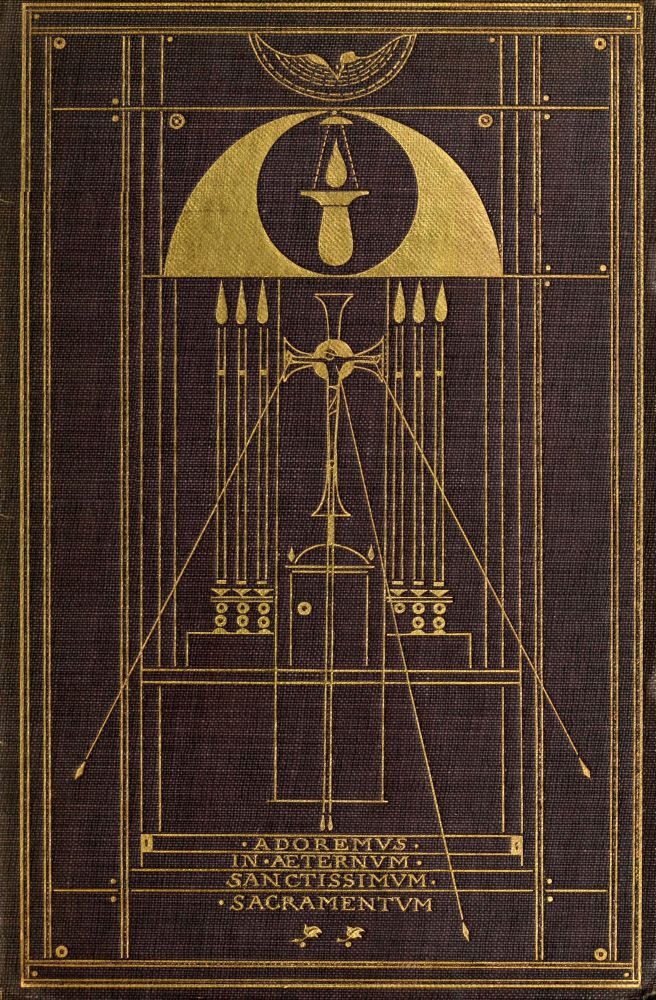
- @Phthoggos We appear to have it already (though with an inconveniently placed barcode) at File:Poems of adoration (IA poemsofadoration00fiel).pdf. From Hill To Shore (talk) 22:01, 18 November 2025 (UTC)
- If you want to upload a clean version of the cover, you can store it in Category:Michael Field (author). If Charles Ricketts was the designer of the cover, the correct licence template would be {{PD-Scan|PD-old-auto-expired|deathyear=1931}}. From Hill To Shore (talk) 22:08, 18 November 2025 (UTC)
PD-scan and a slightly 3D book cover
[edit]Is the PD-scan tag correctly used at File:Holiday (Frank) spine and cover.jpg? Asking because the publisher's logo being engraved into the cover rather than drawn on it is making me have second thoughts over uploading this. prospectprospekt (talk) 01:00, 19 November 2025 (UTC)
_spine_and_cover.jpg)
- The book was published in 1923, so it is out of copyright in the US whether it is 2D or 3D. The book's category says it was published in the US, so there shouldn't be any other country's copyright issues involved (such as the lifetime of the creator of the logo). I'll leave it to others whether there is a specific issue with the PD-Scan template. From Hill To Shore (talk) 01:07, 19 November 2025 (UTC)
- @From Hill To Shore: presumably he was not doubting the PD status of the book, but of the scan.
- @Prospectprospekt: I think that is still close enough to being 2D that there could not be a U.S. copyright, at least, on the scan. This tiny bit of relief is no different legally than if something had been printed on cloth. If it's photographed at an angle that is perpendicular to the page, and the relief is not significant, there should not be any new copyright generated, so PD-scan should still apply. - Jmabel ! talk 06:28, 20 November 2025 (UTC)
- @Jmabel I may be overthinking this, but would the inclusion of the spine create a problem? Many of these "cover and spine" scans exist on the internet, of which I've uploaded this and others here, here and here. I'm worried that the gap between the cover and spine is also 3D and the spine may not be on the same level as the cover. prospectprospekt (talk) 21:23, 20 November 2025 (UTC)
- Presumably, the majority of these scans digitising books will be using some form of mechanical process. Either a flatbed scanner or a camera fixed in position above a flat surface. The operator would then move the book onto the surface to create the scan. I'm not sure what elements of originality would be possible there beyond deciding to scan the full visible surface or part of the surface. Even if there is a 3D element, the image produced would be identical on any similar scanner using a flat surface. If these were photographs of a book taken from some distance, where the camera operator could choose to alter the angle of the camera, you could perhaps argue some elemnt of originality (the changing lighting and shadows across the 3D surface). For these images of books taken on a flat surface, I don't think it would pass COM:TOO. From Hill To Shore (talk) 21:58, 20 November 2025 (UTC)
- @Prospectprospekt: Yes, you are overthinking this. - Jmabel ! talk 23:28, 20 November 2025 (UTC)
- Presumably, the majority of these scans digitising books will be using some form of mechanical process. Either a flatbed scanner or a camera fixed in position above a flat surface. The operator would then move the book onto the surface to create the scan. I'm not sure what elements of originality would be possible there beyond deciding to scan the full visible surface or part of the surface. Even if there is a 3D element, the image produced would be identical on any similar scanner using a flat surface. If these were photographs of a book taken from some distance, where the camera operator could choose to alter the angle of the camera, you could perhaps argue some elemnt of originality (the changing lighting and shadows across the 3D surface). For these images of books taken on a flat surface, I don't think it would pass COM:TOO. From Hill To Shore (talk) 21:58, 20 November 2025 (UTC)
- @Jmabel I may be overthinking this, but would the inclusion of the spine create a problem? Many of these "cover and spine" scans exist on the internet, of which I've uploaded this and others here, here and here. I'm worried that the gap between the cover and spine is also 3D and the spine may not be on the same level as the cover. prospectprospekt (talk) 21:23, 20 November 2025 (UTC)
_cover.jpg)


Request to Remove the Inaccuracy Tag Regarding Copyrightability of Chinese Currency RMB — Copyright Rules Page
[edit]Previous Discussion: Commons:Village_pump/Copyright/Archive/2023/06#Copyright_status_of_Renminbi
Commons_talk:Copyright_rules_by_territory/China#四、货币的版权保护 (Mainly in Chinese)
For a long time, Liuxinyu970226 has claimed that the design of the Renminbi (RMB), the currency of China, is copyrightable because the Measures for the Administration of the Use of Renminbi Designs (人民币图样使用管理办法) states that any use of RMB designs must be approved by the People’s Bank of China, the central bank. I do not intend to deny the copyrightability of RMB designs, but I would like to discuss the exact legal basis for such copyrightability.
I have found several administrative penalty cases showing that individuals who used designs from copyright-expired RMB series (e.g. the 1st, 2nd, or 3rd series) were punished under the Measures for the Administration of the Use of Renminbi Designs. I believe these cases indicate that the Measures impose non-copyright-based restrictions.
For example:
(Chinese, original)
温州市苍南县市场监督管理局苍工商处字字〔2016〕第414号:2013年6月份,当事人温州市八方印业有限公司受北京东方龙文化传播有限公司的委托,承接加工含有人民币图样的中国铁通《第一二三套人民币电话卡》印刷制作业务,具体数量没有确定。2013年9月1日,在未有中国人民银行委托授权的情况下,应客户的要求,通过公司自有印刷设备,擅自予以打样中国铁通《第一二三套人民币电话卡》中的第一套电话卡,共三款,每款30张,后因印制的充值卡版面错误,所印制的面卡全部作废而停止。2014年9月3日,现场存放的CPT版和一张样张被本局龙港分局检查时发现。其未经中国人民银行批准擅自加工含有人民币图样的中国铁通《第一二三套人民币电话卡》,其行为已违反了《中华人民共和国人民币管理条例》第二十七条第一款第(二)项之规定,属擅自制作人民币图样的行为。
(English translation by machine)
Document No. 414 [2016] issued by the Cangnan Administration for Market Regulation, Wenzhou City: In June 2013, the party, Wenzhou Bafang Printing Co., Ltd., commissioned by Beijing Oriental Dragon Culture Communication Co., Ltd., undertook the printing and production of China Tietong “Phone Cards of the First, Second, and Third Series of RMB”, which contained RMB designs, with the specific quantity not determined. On September 1, 2013, without authorization or approval from the People’s Bank of China, the party, at the client’s request, used its own printing equipment to proofprint the First Series phone cards (three types, 30 copies each). Due to errors in the layout of the recharge card, all printed cards were scrapped, and production stopped. On September 3, 2014, during an inspection by the Longgang Branch, a CPT plate and one sample were found on site. The company had processed phone cards containing RMB designs without approval from the People’s Bank of China, which violated Article 27(1)(b) of the Regulations of the People’s Republic of China on the Administration of Renminbi, constituting unauthorized production of RMB designs.
There are nine more similar cases. See Commons_talk:Copyright_rules_by_territory/China#四、货币的版权保护.
I would like to reiterate that I do not intend to deny the copyrightability of RMB designs; I only hope to clarify the correct legal grounds for it.
Therefore, is it possible to remove the tag of inaccuracy regarding the copyrightability of Chinese RMB from the Copyright Rules Page, so that the page can accurately reflect the position I have argued and no longer present it as inaccurate?
By the way, Liuxinyu970226 believes that this issue needs to be discussed in more wikis because removing the tag would have a significant impact and may be opposed by other wikis. However, I do not think that is the case. This matter concerns only the Chinese currency and does not affect the treatment of currency designs from other countries. So I have opened the discussion here to seek further opinions.
@Liuxinyu970226, Wcam, BrightRaven, Jianhui67, King of Hearts, Minorax, Shizhao, VIGNERON, DannyS712, WhitePhosphorus, and Njzjz: Notifying users who are in previous discussions — my apologies if this notification causes any inconvenience. Teetrition (talk) 12:46, 19 November 2025 (UTC)
- Those Gen. I through III RMBs, while most of them are indeed public domain in China due to expired by years, they are most likely still copyrighted in the United States unless if you can really give evidences why they can be {{PD-EdictGov}}. Liuxinyu970226 (talk) 12:59, 19 November 2025 (UTC)
- @Liuxinyu970226
- You mean the Chinese administration punished those people because RMB designs are copyrightable in US?
- Sorry, I really don't see why the Chinese administration should take US copyright law into consideration. If Wikimedia Commons takes the copyright laws of all countries into account, does that mean the Chinese administration should also consider every country's copyright law? Haha. Our focus here is simply on whether this Measures (管理办法) constitutes a non-copyright restriction or not. Teetrition (talk) 15:39, 19 November 2025 (UTC)
- @Teetrition No, but for Gen II, per zh:第二套人民币:
| “ | 其中3元、5元、10元券是在苏联印制,中华人民共和国与苏联交恶后,因为印版留在苏联,且在新疆市场上发现大量在苏联印制的3元、5元和10元券人民币,为免发生意外,因此中国人民银行在1964年4月14日突然宣布,苏联印制版3元、5元、10元于4月15日只收不付,至5月15日全部废弃,停止收兑。 | ” |
- lit.
| “ | Of which the 3¥, 5¥ and 10¥ banknotes are printed in USSR, after PRC and USSR became hostile each other, as print plates are still kept in USSR, and due to many USSR-printed 3¥, 5¥ and 10¥ RMB banknotes found in Xinjiang markets, the People's bank of China therefore, and suddenly announced on 14 April 1964 that to avoid accidents happened, the USSR-printed 3¥, 5¥ and 10¥ RMBs are received but without payments since 15 April, and abandoned on 15 May, and no more cash in allowed thereafter. | ” |
- This at least give me enough caution that not all of Gen II RMBs are made in China, some affected shall really be USSR productions and hence, to be considered copyright status via COM:USSR Liuxinyu970226 (talk) 23:33, 19 November 2025 (UTC)
- @Liuxinyu970226 I don't think that is a matter. It's hard to imagine the Chinese administration and the Measures considered the fact concerning USSR. Even though, what about Gen I and III? There are also cases punishing people only used Gen III w/o prior approval. See 恩平市市场监督管理局恩市场监管横陂处字〔2019〕2号. Teetrition (talk) 02:19, 20 November 2025 (UTC)
- Non-copyright restriction legal basis is better for Wikimedia Commons somehow than copyright restriction argument.
- For people who want to use designs of RMB (gen. 1 to 3) in China, they will know it's not OK to use them w/o prior approval even though their copyright expired. But how about telling them the Measures is a copyright restriction? Someone may think it's OK to use designs of RMB (gen.1 to 3) then because of copyright expiration. Teetrition (talk) 04:56, 20 November 2025 (UTC)
- This at least give me enough caution that not all of Gen II RMBs are made in China, some affected shall really be USSR productions and hence, to be considered copyright status via COM:USSR Liuxinyu970226 (talk) 23:33, 19 November 2025 (UTC)
- The key issue is whether the Measures constitute a non-copyright restriction — which is a legal question, entirely independent of Wikimedia Commons policy. How could a platform policy possibly affect the legal nature of the Measures? Teetrition (talk) 16:01, 19 November 2025 (UTC)
COM:FOP Vietnam - Should it be date of publication, not date of upload?
[edit]Per COM:FOP Vietnam: Freedom of panorama is " Not OK: all uploaded photographs of architectural and artistic works in public spaces from Vietnam, uploaded on Wikimedia Commons from 1 January 2023 onwards."
However, it seems to me that the important date should be the date of initial publication of a file, not the date it was uploaded to Commons. For most own work, this would be the same, but in the case of files like the one at Commons:Deletion requests/File:Ho Chi Minh Mausoleum (26936780921).jpg, the file was uploaded to Flickr in 2016, and only moved to Commons in 2023. The 2016 date should be what we use to determine whether it falls under the old laws or the new ones, because that's when copyright was set.
.jpg)
Should we tweak the language to reflect that? The Squirrel Conspiracy (talk) 17:19, 19 November 2025 (UTC)
- Yes, this would be the only acceptable language. If this is not true, then we would have to delete all pre-2023 Commons uploads relying on FOP Vietnam, since they cannot be freely reused on other websites and therefore cannot be considered to meet the Definition of Free Cultural Works. -- King of ♥ ♦ ♣ ♠ 18:16, 19 November 2025 (UTC)
Romania copyright template
[edit]At {{PD-RO-photo}} I want to change ""According to the Decree no. 321/1956 of June 18, 1956" to "According to the Romanian Decree no. 321/1956 of June 18, 1956". The template currently doesn't mention Romania until the bottom of the template. Any objections? It may be obvious to people adding the template because of the template name, but seeing it displayed it isn't obvious the country is Romania. RAN (talk) 23:43, 19 November 2025 (UTC)
- @Richard Arthur Norton (1958- ): Your proposed change sounds correct to me. - Jmabel ! talk 06:31, 20 November 2025 (UTC)
- Done! --RAN (talk) 17:38, 20 November 2025 (UTC)
File:Chappaquiddick incident by UPI.jpg
[edit]File:Chappaquiddick incident by UPI.jpg has been uploaded to Commons under a {{PD-US-no notice}} license. The photo is credited to UPI and wire service photos such as this from this period can be tricky to assess. Assuming the copyright holder is UPI, it's not totally out of the realm of possibility that the original photo sent out over the wire to various media outlets did include a copyright notice, and, therefore, this release of the photo would be considered "publication" under US copyright law at the time. So, even if the photo did appear in one or more newspapers without an individual notice for the photo itself or in a newspaper without its own copyright notice the paper as a whole, it still could be considered protected under US copyright at the time, couldn't it?

I'm not so sure it a good idea to rely on archive sites like en:Newspapers.com as sources for wire service photos such as this simply because there's no way to know what type of contract a paper might have entered into with UPI for the photo. If this is still protected and assuming the name of the photographer can be figured out, then photo could still be protected per 70 years p.m.a. If it's considered a en:work for hire, it could still be protected until January 1, 2065 (95 years + 1 year after first publication). FWIW, the same photo can be seen used here by en:FOX News and here by en:Der Spiegel, and both sites attribute the photo to en:Getty Images. Another UPI photo of the Chappaquidick site shown here taken a few days after the incident shows a clear watermark and is being licensed by UPI from its official website, which kind of makes me feel that this particular one also could've had a copyright notice that newspapers left out when using the photo. -- Marchjuly (talk) 05:57, 20 November 2025 (UTC)

- You can see the previous discussions like Commons:Village_pump/Copyright/Archive/2025/02#h-Copyright_for_wire_photos_published_from_1963-1978-20250214230200, Special:Diff/425814117#File:Campus_Guns.jpg. I have never seen a copyright notice on a UPI photo you can see a copy of this one here. If UPI had some contract that newspapers should include a notice it was clearly ignored by mass number of newspapers for decades, According to cases like Letter Edged in Black Press vs Public Building Commission of Chicago after repeatedly tolerating publication without notice it cannot be claimed to be unauthorized REAL 💬 ⬆ 09:27, 20 November 2025 (UTC)
- I think you've literally just proved it was sent out without notice. -Nard (Hablemonos) (Let's talk) 11:32, 20 November 2025 (UTC)

Copyright status of photograph in The Sketch with unknown photographer
[edit]I came across a photo of golfer Elsie Corlett in the 9th October 1935 edition of UK magazine, The Sketch. Hoping to add this photo in her wikipedia page (since she doesn't have one), I was trying to find out the photographer to check if the photo would still be in copyright or not. However, I could not see any credit on the page (and don't have access to the whole edition so cannot see if there is any credit listed in the inside page for example). I'm hoping someone could advise me of the copyright status of such a photo.
I have asked in Wikimedia Media copyright questions and was directed to here. Whether this is a UK copyright issue (where the magazine was published) or a Wikipedia servers location issue.
Any advice would be welcome. PitterPatter533 (talk) 13:41, 20 November 2025 (UTC)
- Unfortunately, this photo will be copyrighted under URAA until January 1, 2031. After that date you may be able to apply {{PD-UK-unknown}} if the photographer truly is anonymous. -Nard (Hablemonos) (Let's talk) 16:49, 20 November 2025 (UTC)
Copyright of Thai scouts flags
[edit]Category:Flags of Thai Scouting consists of some very sophisticated images that are clearly above threshold of origin. Assuming that these are the correct flags, should they be allowed on Commons? {{PD-TH-exempt}} only allows for government work. When I look at their regulations, Thailand's National Scout Committee is established by the government, headed by government officials, but is considered "a state agency in which is neither a government agency nor a state enterprise under the law on budget is procedure and any other laws". -- 痛Designism (talk) 03:54, 21 November 2025 (UTC)
- Also, I believe at least some of these contain only non-copyrightable variations on things that are old enough to be in the public domain. E.g. it would surprise me if there were anything copyrightable about [[:File:Flag of the Scouts of Nakhon Chai Si.svg] or File:Flag of the Scouts of Udon.svg. - Jmabel ! talk 21:15, 21 November 2025 (UTC)

Where is the line between fair use and not eligible for copyright?
[edit]How short does a text have to be before copyright is no longer applicable? I was thinking of adding an image that compares how some (print) encyclopedias have formatted their cross-references. Could I use photos of single words? Could I include the adjacent (non cross-referenced) word? Are the line below too short for copyright, or would they be fair use and not elligble for an image on the Commons?
- "wuxing, translated as ☞'five agents' or 'five phases';"
- "☞donkey, grapefruit, knees"
- "(SNPs); [☞'SNP'] on one chromosome or part of a chromosome"
Rjjiii (talk) 07:10, 21 November 2025 (UTC)
- In court :) —TheDJ (talk • contribs) 09:17, 21 November 2025 (UTC)
- Lol. Fair. I'm just going to use an older public domain book. Rjjiii (talk) 09:23, 21 November 2025 (UTC)
- FWIW, in the U.S., some of Ashleigh Brilliant's aphorisms have been successfully defended as copyrightable. These are typically sentences about 7 words long. However, the court decision was based on the fact that they were, well, brilliantly concise, and were therefore eligible for copyright despite their brevity. - Jmabel ! talk 21:19, 21 November 2025 (UTC)
- Lol. Fair. I'm just going to use an older public domain book. Rjjiii (talk) 09:23, 21 November 2025 (UTC)
telif hakkı olup olmadığı kesin olmayan fotoğraflar hakkında?
[edit]nasıl görsel ekleyeceğiz? Kalkanzade (talk) 17:03, 21 November 2025 (UTC)
- @Kalkanzade: Hi, If the copyright is uncertain, the picture is probably not OK for Commons. But without any more information, it is difficult to say. Do you have any example? Yann (talk) 17:10, 21 November 2025 (UTC)
- Merhaba, bu mecrada yeniyim ve hiçbir bilgiye hakim değilim. Örneği sana nasıl ulaştırabilirim? Kalkanzade (talk) 17:29, 21 November 2025 (UTC)
- (reading via Google translate) @Kalkanzade: if it is already online somewhere, you can provide the URL of the relevant web page. If there are multiple images on that page, be clear about which one you are referring to. - Jmabel ! talk 21:22, 21 November 2025 (UTC)
- Merhaba, bu mecrada yeniyim ve hiçbir bilgiye hakim değilim. Örneği sana nasıl ulaştırabilirim? Kalkanzade (talk) 17:29, 21 November 2025 (UTC)
Bulk-correcting false license
[edit]Files that are shown in this search query all have a wrong license. I think all of them should have the CC-BY-4.0 license set as is standard for most files by OWID. Maybe it would also be good to notify repeat uploaders of these files with wrong license via some talk page message so they don't continue setting wrong licenses to the files.
Could somebody correct them?
Maybe info on how to do such or request such bulk-corrections may be good to document somewhere. Prototyperspective (talk) 18:13, 21 November 2025 (UTC)
- @Prototyperspective: This sort of thing is pretty easily done with VFC. - Jmabel ! talk 21:23, 21 November 2025 (UTC)
- How? When I on that search results page go to Tools -> perform batch task to open VFC and then select search query and, because it has my username in that input box instead of the search query of the search, paste search query into it, it doesn't show any results to run custom replace on. Additionally, I don't know which licenses people selected so it should custom replace all license tags – if this indeed works with VFC maybe somebody here has the regex for that. Prototyperspective (talk) 21:55, 21 November 2025 (UTC)
- You have to click go on Special:Search
- REAL 💬 ⬆ 01:07, 22 November 2025 (UTC)
/==\{\{int:license\-header\}\}==\n\{\{.*\}\}/g- I wouldn't necessarily presume that all of the licenses are in a "license-header" section and that no other templates are in there; I think that particular regex could get you in trouble.
- When I've done this, I've usually expected to do a few passes with VFC, looking through the search results for licenses that are present, and knocking out one license at a time (or a few at a time if I can find a good regex, e.g.
\{\{PD-[^[}]*\}\}should get every sort of PD without catching anything else). After each pass, there should be fewer search results. - Jmabel ! talk 01:22, 22 November 2025 (UTC) - Thank you very much! It's a problem that VFC doesn't work in MediaSearch and even not in special search except if one opens a new tab to Special:Search and then opens it from there. Your regex worked on all but a handful of files which e.g. were marked as Own work or missing infobox template. Will fix these at a later point. Jmabel, OWID files generally only have one license template but using this regex for other cases could be a problem. Prototyperspective (talk) 01:28, 22 November 2025 (UTC)
- How? When I on that search results page go to Tools -> perform batch task to open VFC and then select search query and, because it has my username in that input box instead of the search query of the search, paste search query into it, it doesn't show any results to run custom replace on. Additionally, I don't know which licenses people selected so it should custom replace all license tags – if this indeed works with VFC maybe somebody here has the regex for that. Prototyperspective (talk) 21:55, 21 November 2025 (UTC)
Star Wars Stormtooper cosplays
[edit]What's the current situation in regard to Star Wars cosplay of Stormtroopers? Is that kind of motif rather governed per COM:COSTUME and predominantly deemed OK or is that a case of depicted models and thus a possible copyvio? I'm quite sure that there were some discussions, examples, essays and helping texts around, but I forgot where. Regards, Grand-Duc (talk) 01:01, 22 November 2025 (UTC)
- A UK case ruled that Stormtrooper helmets (and possibly by extension the rest of the armor) was uncopyrightable as the armor was functional, covered only by a 15 year design right in w:Lucasfilm_Ltd_v_Ainsworth. Note the court declined to rule on the copyright status of the Stormtrooper gear in other countries, stating only that it was legal in the UK. -Nard (Hablemonos) (Let's talk) 06:17, 22 November 2025 (UTC)
Restored logo
[edit]Hello; I amatorially made a digital version (with color) of the logo of the italian political party Democrazia Proletaria (Proletarian Democracy); taking inspiration from a photograph in which the logo can be seen behind a politician (Luigi Cipriani) from that party.

Can I upload the file I made or is it under copyright since I didn't make the original logo? Firedbolt (talk) 13:41, 22 November 2025 (UTC)
Are World Inequality Database data graphics in the public domain?
[edit]WID was added to Commons:Free media resources/Datagraphics but as far as I can see they failed to put the graphics under a free license like CCBY (and it's not unlikely nobody has asked them about it so far). For now, I just moved it under a section "Resources that do not specify a free license".
Are these or many/most of these data visualizations indeed clearly in the public domain ({{PD-map}} and {{PD-chart}})?
Prototyperspective (talk) 13:59, 22 November 2025 (UTC)
- Website footer says
"Our charts, articles, and data are licensed under CC BY, unless stated otherwise."
Andy Mabbett (Pigsonthewing); Talk to Andy; Andy's edits 16:09, 22 November 2025 (UTC)